Sunday, December 7, 2014

smooze

Alejandro Rodriguez
12-6-14
Smoozing Project

            So for my smoozing project I went to the small art talk for the Fort Worth based new media artist Christopher Blay. The lecture itself was very informal, Blay wanted it to be very lax and not too up tight, from my time with him that just seemed to be that type of guy he is. After the lecture, I was able to talk to for a little bit. I told him that I too was a new media artist, though I didn’t have anyway to show him my work, though he didn’t take any offence to it. We talked a little a bit about our work, but the real meat of our conversation was when he stated telling me about the art community in Fort Worth. He said he so much more prefer the art community of Fort Worth, as oppose the community in New York, was because the artist in Fort Worth had a more tight and diverse network with one another. Its one of those situations where everyone knows everyone and that there’s a friendlier bond amongst them that doesn’t have a harsh competitive nature to it. This is where Blay said, for him, it was more important to have a friendly network of artist like this than one where you so happen to have the card of another artist you met once. He said that his style of community prosper more creativity for not only his art, but for his peers too. With this I agreed with, mainly because I seem to operate in the same way, I have a tight clique of friends and artist whom all know each other, and actually care about one another.   

Friday, December 5, 2014

Scmoozing? is this the class? oh god.... where am I?


A Far Thing Coming Closer @ Centraltrak


Dallas used to intimidate me when I was younger, I am a more hardened animal now, and Dallas can’t scare me. I know the rules; if you don’t muscle into the lane you need, you’re going to miss your exit, don’t park in sketchy places unless you have made peace with the possibility that someone may break your window to carve the AM/FM cassette out of your dash (with what you can only assume was a butter knife), and when a spun man on crutches offers you a dollar at a red light, for god’s sake, don’t take it.

                While the city of Dallas itself does not intimidate me, the people there do. It’s a funny feeling to stand in a room full of strangers, it feels like falling. Pippins and I had an assignment though: SCHMOOZE, talk to people and forge the connections necessary for success. I liked all the films. It’s was kind of schizophrenic to change gears so quick from one to the next, how much can a person really retain viewing film in this situation? I was thinking a lot about how terrible it would be if I was sitting up in those seats, getting the questions… I’m never going to be able to handle that. We went outside to smoke, met some ladies whose names I cannot remember. Pippins got mad that I told them we were students. She thinks that if they know we are just undergrads, they won’t take anything we say seriously. I think she was being influenced by our experience the last time we came to Centraltrak, things were way less relaxed and we sat at the bar for a good 2 hours, too scared to pee while we got talked at and I got lectured about being too dependent on new technology.

We met an artist with a BA named john, he lives in Dallas and goes to all the gallery shows he can. He works as an office assistant, but by night he is a film maker. He is coming to the Black Lodge I hope, I wrote the date and time down for him on a piece of paper which, hilariously enough, had my process notes about making contact prints with film on the back.

In summation, Pippins and I saw some Cinema, then we saw a Q&A session which led me to quite egocentrically question my own integrity, we observed a peaceful and happy group dynamic amongst artists, and we met a cool guy named John.


Interesting use of the word ‘enemy’ here…


Tuesday, November 4, 2014

Marks' Post

I think Marks has an interesting point of view when it comes to single-channel experimental films fighting to stay "alive" between the decline of festivals and the lack of galleries wanting to show them. However, it's very difficult for me to fully agree or disagree with all of her statements...

Why does this all revolve around money? She seemingly does not care about it, but at the same time she bases success as an artist all on funding and pay. I mean, I will admit I have fallen into the same trap of believing money = success, but I am starting to believe that sometimes using free social media sites can lead to success and THEN to money, rather than the other way around as she believes (Such as YouTube channels who make a ton of money currently, but only because they went "viral." Now given, these are internet phenomenon rather than film and video, but she mentioned YouTube and Vimeo, so I figure my comment is not said entirely on a tangent).

One point that I was very intrigued about was her discussion on films/videos that last for an incredibly lengthy amount of time. I appreciate her snarky-ness when she counters Morgan's opinion with "I question whether a distracted culture needs distracted art experiences in the first place."
That is one thing that is very accurate when it comes to our culture in my opinion: our lack of focus, our short attention spans, etc. Just an unfinished thought.

Monday, November 3, 2014

Render Farm Info

Hey everyone.

Ok, so Gabriel has sent some information about using the render farm. There may have been updates to things that might complicate this, but he's going to come to the Expanded Cinema class Tomorrow (tuesday) to give a quick demonstration for anyone who needs to use it. So if you're not in that class, maybe see if you can drop by or get someone to take notes for you.

Here's a link to the info Gabriel sent: http://www.thinkboxsoftware.com/deadline-5-maya/#Job_Submission

Thursday, October 23, 2014

Cracked Ray Tube workshop at Oil and Cotton via Dallas Medianale

Hey guys. I want you to have first dibs on these, but they're open to the public.

In January, the Dallas Medianale (an extension of videofest i'm working on) will host DIY video synth building workshops led by the members of Cracked Ray Tube. Check it out: http://oilandcotton.bigcartel.com/product/jan-10-hardware-hacking-and-diy-audio-video-synthesis-workshop

If you want to see a bit more of what this stuff does, see here:


Wednesday, October 15, 2014

Poetry holds the place Conceptual Art used to...Kenneth Goldsmith

I wrote down a lot of quotes made by Kenneth Goldsmith in the podcast and even some articles about him that I researched. Intriguing concepts that plagiarism is now the the New Aesthetic... 'all stolen", creativity is debunked in Goldsmith's classes--No "creative" writing allowed. By being forced to use other's work and change the context by its new placement within a document is actually how true creativeness happens ( harder than it sounds, I am sure. )
A Conceptual Art mantra?

* " a movement of observation"
* "the Lifestream is on 24/7 "
* " the warmth of a seat that has been left"  Duchamp.
* "pointing not making"
* '"a state between states"

I feel I should have stolen these boldly instead of using quotation marks. Next time...in my art...where it counts.

Tuesday, October 7, 2014

OH MY!


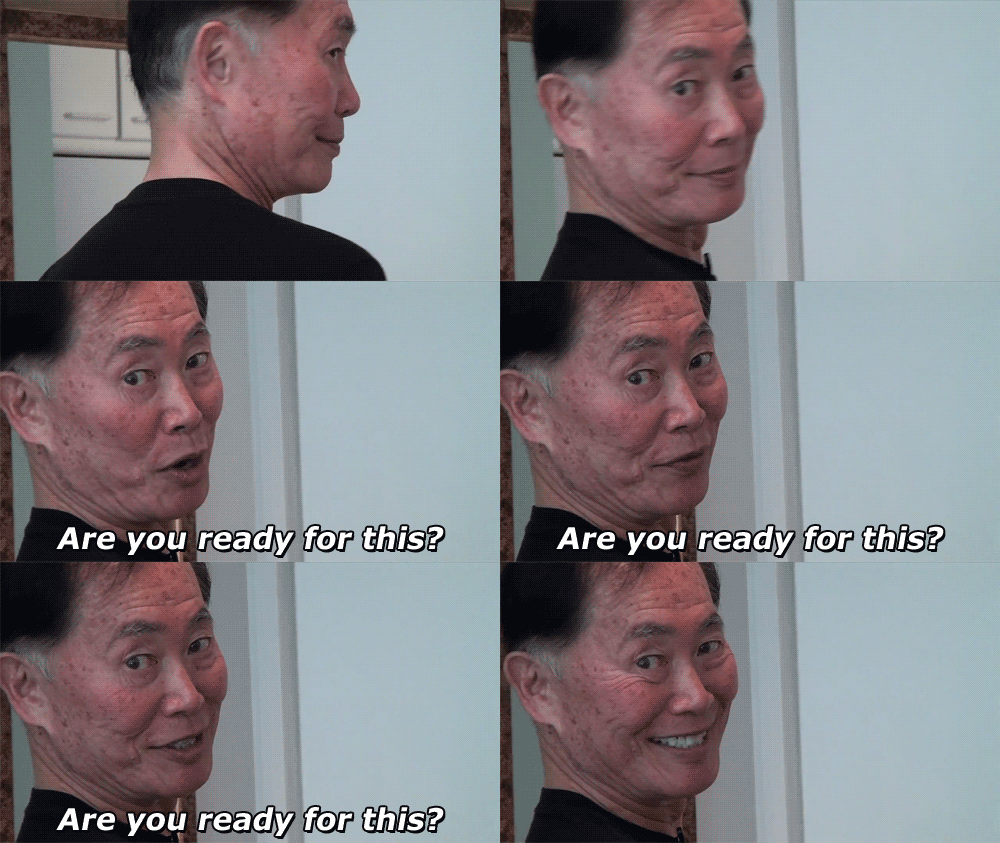
George Takei will be speaking in the Coliseum at UNT on Oct 27 at 8pm. 

Tickets for students is $5
Faculty and Staff is $10
Public Guests are $15

This is on a Monday which is why I am posting it for Advanced. If you want to see George Takei live and in person speaking as part of the Distinguished Lecture Series program then don't miss out. The Distinguished Lecture Series program introduces the UNT community to the excellence of world-class speakers whose messages enhance student learning outside the classroom.

It may not be art related but maybe we can get a little insight on how some of Star Trek was filmed. Who knows what he'll talk about but I surely want to go! 


Sunday, September 28, 2014

Molesworth/Barthes - Whitney Ratliff

Painting is not dead! 


Helen Molesworth, a chief curator at the Museum of Contemporary Art of Los Angeles, talks about some of her exhibitions and the conflicting issues she had with chronological sequencing. She says by placing photos in slideshows in chronological order or in groups by the decade, seemed boring and that that language isn't as influential alone but the images are more influential outside of that language, and that the language around the decade was so strong, it was so out of favor. If she reconfigured it outside of that language, she felt like the work itself emerged in a different way. By historizing the work in the moment made the work itself feel tainted.

The impact of criticism has on an art form is perceived by the culture, based on what is popular or in demand. "Criticism doesn't function in a highly speculative market, criticism functions in a depressed market where consensus building is more of the aim of the goal." Critics is a harder and rarer career to make. "The language of criticism and the impulse of criticism got pulled up in non-institutionally affiliated culturial projects. (I think that is what she said) A lot of the gravitas that were traditionally appointed to a critic was given to the curator." Critics and curators have essentially become one and the same but each holds its own fundamental goal to present the work and respect it as it is as well as what it is not.


Barthes
"Of course this epithet, to which we turn and return out of weakness or fascination (parlor game: discuss a piece of music without using a single adjective), has an economic function: the predicate is always the rampart by which the subject's image-repetoire protects itself against the loss that threatens it: the man who furnishes himself or is furnished with an adjective is sometimes wounded, sometimes pleased, but always constituted, music has an image-repretoire whose function is to reassure, to constitute subject, who hears it (would this be because music is dangerous--an old Platonic notion? Leading to ecstasy, to loss, as many examples from ethnography and popular culture would to show?)"

- Barthes, Grain of the Voice, pg 267-8

"The romantic "heart," an expression in which we no longer perceive anything but an edulcorated metaphor, is a powerful organ, extreme point of the interior body where, simultaneously and as though contradictorily, desire and tenderness, the claims of love and the summons of pleasure, violently merge: something raises my body, swells it, stretches it, bears it to the verge of explosion, and immediately, mysteriously, depress it, weakens it."

- Barthes, The Romantic Song, pg 289

"It is because Schumann's music goes much father than the ear, it goes into the body, into the muscles by the beats of its rhythm, and somehow into the viscera by the voluptuous pleasure of its melos: as if on each occasion the piece was written only for one person, the one who plays it; the truth Schumannian pianist -- c'est moi."

-Barthes, Loving Schumann, pg 295

These were just a view quotes I thought captured a good essence of each written piece by Barthes. Barthes does a great job analyzing the art of music and how it is presented poetically to the ear of its listeners. He describes current uses of work, such as the piano as a "nouvelle cuisine uncooked", most likely referring to current performances as being not as powerful or mesmerizing in good fashion as it once was when the piano was presented for a few listeners and more private performances of higher status. Music to the ear, is an intimate relationship between the listener who envelopes oneself into the work with great passion. It stimulates the ear into a state of euphoria in an emergence of pleasure and love. However, the voice as he describes in The Romantic Song, portrays two different sides that can be best summarized as being good and evil. A light and dark voice, one that displays an amorous, unisexual role within society towards love and passion or a demonic, diabolic evocation that divides, separates, dissociates, and dismembers the body.  Both affect the lost, the abandoned subject that the romantic song sings.

Monday, September 22, 2014

Shows at which to Shmooze

Ok, here are a few more options. One of them is in Denton, for those of you who hate to drive.

There's a Panel on Art in New York during the 80's on Tuesday at the Fort Worth Modern. Those of you thinking about what kind of art careers you might like to have can find models to emulate or work against here:

http://glasstire.com/events/2014/09/18/panel-urban-theater-new-york-art-in-the-1980s/


Michelle Mackey, Marcelyn McNeal, and Lorraine Tady at TWU September 30th

http://glasstire.com/events/2014/09/18/michelle-mackey-marcelyn-mcneil-lorraine-tady/


Aways in the back

This lecture was interesting mainly because it supports the idea that it the small, or less noticed, actions in time that make the large events that end up making history. Society would like for us to believe that great ground breaking events and people come to be as an instant influential force, that they were born that ground shacking, ignoring all the details leading and making up that said event. Really, these great people were influence and inspirited be so called smaller forces that made them who they are, and that they themselves are a small part of a even bigger movement. Everything big starts from the back door to become the front door.

Kenneth Goldsmith - Whitney Ratliff

"Poetry, today, occupies the position that conceptual art once held in the art world. Conceptual art was in its inception an act of resistance, one through the dematarialization called into question the status of the unique art object and the sole privilege of the author propose that art can be made by anyone regardless of their skill set. And it also claimed that art could have democratic distributions able to be experienced by all. Of course we know today that conceptual art has been thoroughly degraded into the canon of art history and has acquired great value. And yet its original utopian ethos lives on continually providing much needed framework, strategies of resistance, and roadmaps of art dematerialized, and radical democratic, digital world." - Kenneth Goldsmith (At 20 minutes)


Goldsmith talks about using the back door as the front door and how poetry is important and how using the back door is, for most of the time, the better way to into the art world. He explains in further detail poetry in relationship of conceptual work and continued by individually looking at artworks and explaining their construction and meaning about the piece and its relationship with the much wider world during a certain timeframe in history.

He later lists off everything society is doing such as tweeting, talking, facebooking etc except for paying attention to the art on the wall, that the art on the wall has become secondary to everything else in the world. No one is stopping to smell the roses. Everyone is in a rush, constantly wanting an instantaneous relationship with others and not understanding the meaning behind the art on the wall and stopping to enjoy the moment or to go and see a person in person rather than creating this distance between others and holding that relationship as more important than actually facing the person physically.

Sunday, September 21, 2014

Clarification...

Hey everyone. It seems people are confused about what to blog on for tomorrow. Unfortunately, my email just stopped working altogether and I can't send the response where I set the record straight, but here's a link to the podcast you should be listening to: http://www.themodern.org/sites/default/files/kenneth_goldsmith3.25.14.mp3


Sorry for the confusion. You also should have pdfs for the Roland Barthes reading for next week, but if not I'll resend those once my email starts working again.

Mike

Sunday, September 14, 2014

Bad @ sports: 330 Carolee Schneeman

       Carolee Schneeman is a character! This was a pretty interesting talk and good overview of Schneeman's thoughts on her own work. It was interesting to hear her talk about how she viewed her work at the time of creating it. She talked about how she was not misunderstood but that she had misunderstood her culture and what they were ready to receive. She mentioned was always shocked when her pieces were censored but now she is equally shocked when the censors are removed. Schneeman describes her early work at the juncture of sexuality and politics, but also how her painting was a personal venting of energy.
        She talks about how her early work studied gender roles a lot but in a way that focus more on men and how they would handle domestic normalcy that women are so often placed into. She talked about one of her first models being a man and how that was so different than the norm or women as models. It was interesting to listen to Schneeman who sounded like such a soft spoken lady, when her work had been anything but. I wonder how much has changed over the years. I think she feels she has spoken her peace on the body, saying that she will leave the body to other artists and seek to regain privacy in her own life.
    My favorite line was when the interviewer asked her "what is the most important truth you have discovered as a multidisciplinary artist and educator?" to which she responded: "To have a psycho, sensitive cat that sleeps with you every night."

Saturday, September 13, 2014

Carolee Schneemann - Whitney Ratliff

Last week, I messed up. I posted the BAS about everyone but Greg Sholette! Guess, I didn't listen to all of it. Oops. 


In Carolee Schneemann's podcast, Schneemann talks about her artwork from when she first became an artist and what fueled her inspirations to create artwork that pushed the discourse of the human body, sexuality, and gender within society's perspective. One point she makes is that her and her respective artists were all hugely influential bringing together the intensity of their cultural discoveries and that she had brought issues of painting, not only with what she was doing but what she was learning at the time as well. Most of her works that were the most iconic even to this day were created in the 60's and 70's. Her mantra now is, "My use of my body reflected the body of the work." 

This podcast was a good overlook at all of Carolee Schneemann's past and present works. I felt like the questions asked were very insightful and well presented. It covered a lot of and Carolee was very open and humble with her responses. 

Thursday, September 11, 2014

Alejandro's response

Ok so I accidentally listened, and made a response to this weeks podcasts last week. I could do the responsible thing and say that it was a mistake in my part, but instead I;m going to blame Mike, this is his fault :). Anyways, one question I still have for this podcast is whether the artist feels like there has been a tremendous amount work done by female artist, in means of have they gain better recognition or say in the art world, to does she think that there is still plenty more to do? She's been in this line of work far longer than any of us so I feel she would be a good candidate to help answer this question.

Monday, September 8, 2014

Bad @ Sport #413


   This was really interesting, I liked that they talked to a few different people during the podcast. That being said I feel like there were a couple different thoughts going on, as each person was being asked different questions. I think overall this podcast is really trying to give listeners a view of what SIGGRAPH is and what it hopes to achieve.  I think the first segment with Victoria Szabo was one of my favorites and made the most sense. I loved how she described the work on display, normally a difficult task but I could very nearly picture it. Szabo mentioned being inspired by William Blake's "Auguries of Innocence", and quoted a segment:
  "To see a World in a Grain of Sand
And a Heaven in a Wild Flower 
Hold Infinity in the palm of your hand 
And Eternity in an hour."
1) I loved this. 2) I think this is just a great picture of what New Media is, especially the last line. I think about how is my own work I've loved the exploration of manipulating time digitally. Szabo also talked a lot about how SIGGRAPH hopes to bridge the gap between art and technology. I think Jackie Morie also mentioned collaboration and how SIGGRAPH encourages artists and scientists to work together and inspire each other.
  This is one of the things that I think is the most beautiful about New Media. I think it is so versatile and really reaches and branches out into different fields that would otherwise not be paired with art. Ultimately New Media makes connections that couldn't otherwise happen.
   The last segment about "dark matter" was most confusing to me. It involved a lot of politics the speakers seemed a bit argumentative. They talked a lot about the art world and how some people sink into invisibility and others make it big. I think that is what they mean when they talk about "dark matter?"

Bad at Sports XYZN Scale Response

I guess the main theme I hear is about bringing the spatial element in art back into the digital world, where it can become so screen based ( the science ) into a blend ...right brain/left brain art with all kinds of art-making. It feels free to be personal and use whatever media you want with a piece that will express something even if only to you, but successful when it can express to many. Always a coin toss I suppose, but I agree when combining functionality (science) to artfulness it truly is a marriage of science and art that might benefit humanity. Scientist and Artist...both experiment.

Bad at Sports

What is interesting about SeaGraph is the ability that it has to bring artists and scientists together in a meaningful way that becomes mutually beneficial. I often find that artists represent scientific concepts very well, but in ways that aren't really very beneficial in any way to the scientific community. When we really create functionality with our art is when we can hone in on the needs of scientific community and provide aesthetic in any number of various forms. For it has always been artists who present science in an aesthetically meaningful way, ever since we first began illustrating anatomy and new species. As we develop and learn new technologies we have the ability to teach society in a very exciting and engaging ways.